
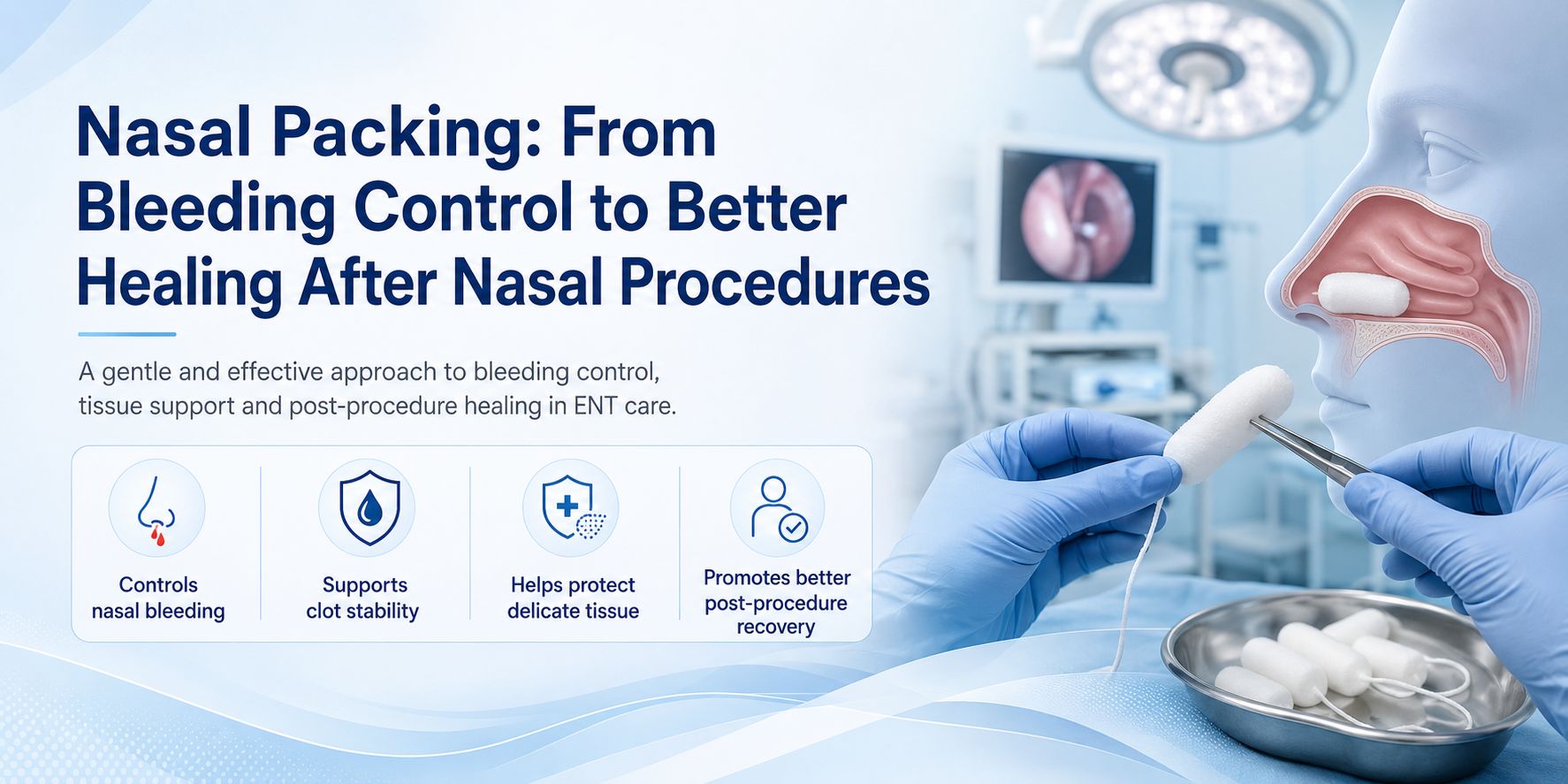
Nasal Packing: From Bleeding Control to Better Healing
Nasal bleeding can occur after an injury, during an episode of epistaxis, or following an ear, nose and throat procedure. Although minor bleeding often settles with basic first-aid measures, persistent or postoperative bleeding may require additional clinical support.
Nasal packing is a commonly used technique that helps control bleeding, supports the tissues inside the nasal cavity and creates a more stable environment for recovery.
The type of nasal packing selected can influence haemostasis, patient comfort and postoperative care. Depending on the clinical situation, healthcare professionals may use absorbable nasal packing, non-absorbable packing, inflatable devices or nasal splints.
What Is Nasal Packing?
Nasal packing involves placing a specially designed material or device inside the nasal passage to apply gentle pressure to the bleeding site. This pressure compresses affected blood vessels, supports clot formation and helps reduce continued blood loss.
Nasal packing may also be used after ENT procedures to support delicate tissues, limit blood accumulation and protect the surgical area during the early stages of healing. It is frequently considered in the management of persistent epistaxis and following procedures such as septoplasty, sinus surgery and other nasal interventions. (Aegis Lifesciences)
Nasal packing should always be selected and positioned by a qualified healthcare professional according to the patient’s condition and the requirements of the procedure.
Why Is Nasal Packing Used?
The primary purpose of nasal packing is bleeding control, but its clinical role can extend beyond haemostasis.
1. Helps Control Nasal Bleeding
Nasal packing applies local pressure against the bleeding surface. This compression helps reduce blood flow and supports the body’s natural clotting process.
It may be used when direct pressure, topical treatment or cauterisation does not provide adequate control, or when the precise bleeding point cannot be easily identified.
2. Supports Clot Stability
Once a clot begins to form, movement and repeated irritation can disturb it. Nasal packing helps maintain contact with the bleeding site and provides a more stable environment during the initial healing period.
3. Reduces the Risk of Blood Collection
Following nasal surgery, blood may accumulate between tissue layers and contribute to the formation of a haematoma. Appropriate packing may help limit this accumulation by providing controlled internal support and pressure. (Aegis Lifesciences)
4. Supports Nasal Structures
After procedures involving the septum or surrounding tissues, nasal packing may help stabilise the treated area. This can be useful while tissues begin to settle into their postoperative position.
5. Protects the Surgical Site
Packing can provide a physical barrier that protects sensitive nasal tissue from repeated contact, movement and irritation during the early recovery period.
Common Types of Nasal Packing
Nasal packing materials differ in composition, absorbency, expansion, flexibility and removal requirements. The most suitable option depends on the severity of bleeding, the procedure performed and the condition of the nasal tissues.
Absorbable Nasal Packing
Absorbable nasal packing is designed to gradually break down inside the body. It may be made from materials such as gelatin, polyurethane foam, hyaluronic-acid-based materials or other biocompatible substances.
A major advantage of absorbable packing is that a separate removal procedure may not be required. This can reduce discomfort associated with pack removal and minimise the possibility of disturbing newly formed tissue or clots.
Absorbable nasal packing can be particularly useful for mild to moderate bleeding, postoperative support and situations where atraumatic healing is a priority.
However, absorbable packing does not provide the same degree of compression in every clinical situation. Product selection should therefore be based on the required haemostatic effect and the treating professional’s assessment.
Non-Absorbable Nasal Packing
Non-absorbable packing remains inside the nasal cavity until it is removed by a healthcare professional. Common examples include traditional gauze, polyvinyl alcohol sponges and certain inflatable balloon devices.
Some non-absorbable packs expand after absorbing fluid. This increases pressure against the nasal walls and may provide stronger mechanical compression in cases of significant bleeding.
Because these materials require removal, the timing and method of removal must be carefully planned. Removal may cause temporary discomfort and can occasionally disturb the healing surface.
Balloon Nasal Packing
Balloon-based nasal packing uses an inflatable device to apply targeted pressure inside the nasal cavity. The pressure can be adjusted according to the location and severity of bleeding.
These devices may be considered when localised compression is required. Correct inflation and placement are essential to avoid unnecessary pressure on surrounding tissues.
Nasal Splints
Nasal splints are generally made from silicone or another flexible material. They are commonly used after septal surgery to support internal structures, prevent unwanted tissue contact and maintain alignment.
Although splints can contribute to postoperative support, their primary role differs from purely haemostatic packing. The treating surgeon determines whether packing, splints or a combination of both is appropriate.
How Absorbable Gelatin Nasal Packing Works
An absorbable gelatin sponge has a porous structure that absorbs blood and provides a physical matrix where platelets and other clotting components can collect. This supports the formation and stabilisation of a clot at the bleeding site.
The material can gently conform to the shape of the nasal passage and maintain contact with irregular mucosal surfaces. Because it is bioresorbable, it gradually breaks down without requiring routine physical removal.
Absorbable gelatin packing is generally used as an adjunct to appropriate clinical and surgical techniques rather than as a replacement for vessel ligation, cauterisation or other definitive methods when these are required.
Clinical Applications of Nasal Packing
Nasal packing may be considered in:
- Persistent anterior or posterior epistaxis
- Bleeding following nasal trauma
- Septoplasty and septal procedures
- Functional endoscopic sinus surgery
- Turbinate procedures
- Rhinoplasty and rhinoseptoplasty
- Minor ENT interventions
- Postoperative nasal wound support
The decision to use packing depends on bleeding severity, anatomical location, patient history and the risk of postoperative complications.
ZICOSPON® Nasal Tampon Sponge by Zichor Life Tech
Zichor Life Tech offers ZICOSPON® Nasal Tampon Sponge, a sterile and absorbable gelatin haemostatic solution developed for nasal and ENT applications.
Its soft, porous structure is designed to absorb blood and fluids while supporting local clot formation. The sponge is flexible and can be positioned within narrow or irregular nasal passages. It is bioresorbable, which can eliminate the need for routine removal when used according to the approved instructions.
ZICOSPON® Nasal Tampon Sponge is available in multiple nasal tampon, sponge, strip and film configurations. Zichor Life Tech also provides customised sizes, OEM manufacturing and bulk supply options for hospitals, distributors and medical-device brands. (Zichor Life Tech)
Important Considerations During Nasal Packing
Nasal packing is a clinical procedure and should not be attempted without professional guidance. Incorrect placement may cause excessive pressure, tissue injury, breathing difficulty or inadequate bleeding control.
Healthcare professionals should consider:
- The source and severity of bleeding
- Absorbable versus removable material
- Required compression level
- Patient comfort and nasal anatomy
- Anticoagulant or antiplatelet medication
- Infection risk
- Duration of placement
- Product-specific instructions and contraindications
Patients should seek urgent medical attention if nasal bleeding is heavy, follows a major injury, causes breathing difficulty, continues despite pressure or is accompanied by weakness, dizziness or significant blood loss.
Conclusion
Nasal packing plays an important role in controlling bleeding and supporting recovery after nasal injuries and ENT procedures. It can provide compression, stabilise clots, protect delicate tissues and support postoperative healing.
Absorbable packing offers the advantage of gradual resorption and may reduce discomfort related to removal. Non-absorbable packing can provide stronger mechanical compression but generally requires planned removal.
The correct nasal packing material should always be selected according to the clinical situation, bleeding severity and professional judgement. With appropriately designed absorbable solutions such as ZICOSPON® Nasal Tampon Sponge, Zichor Life Tech supports effective haemostasis and patient-focused care in nasal and ENT procedures.
SEO title: Nasal Packing: Uses, Types and Role in Bleeding Control
Meta description: Learn what nasal packing is, how it controls nasal bleeding, the differences between absorbable and non-absorbable packing, and its role in ENT recovery.
Main keyword: Nasal packing
Secondary keywords: absorbable nasal packing, nasal tampon sponge, nasal packing for epistaxis, nasal haemostatic sponge, ENT nasal packing, postoperative nasal packing