
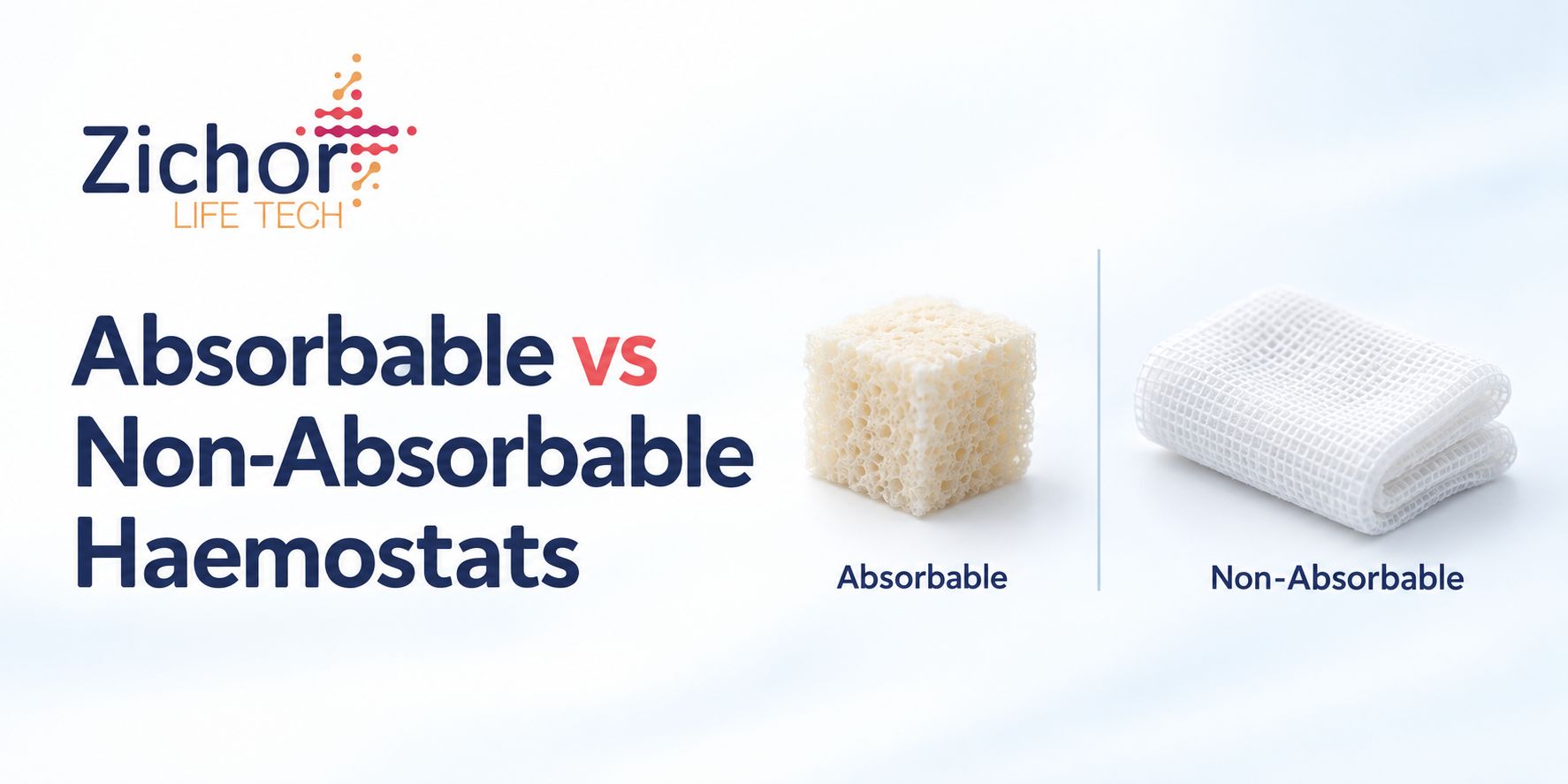
Absorbable vs Non-Absorbable Haemostats
Controlling bleeding is one of the most important priorities during surgery. Surgeons commonly use pressure, sutures, ligatures and electrocautery to achieve haemostasis. When bleeding is difficult to control or the surgical area is delicate, a topical or mechanical haemostat may be used as an additional method. Topical haemostats are generally used as adjuncts when conventional bleeding-control methods are ineffective or impractical.
Haemostats are available in absorbable and non-absorbable forms. Although both support bleeding control, they differ in composition, mechanism, duration inside the body and need for removal. Understanding these differences helps healthcare professionals select an appropriate solution for the procedure and bleeding site.
What Is an Absorbable Haemostat?
An absorbable haemostat is a sterile material designed to control local bleeding and gradually break down inside the body. Depending on the product, it may be made from gelatin, oxidised cellulose, collagen, fibrin-based materials or other biocompatible substances.
Many absorbable haemostats provide a porous surface or physical matrix where blood can collect, platelets can adhere and a stable clot can form. Some also absorb blood and fluid, helping concentrate the natural components involved in coagulation.
Because the material is absorbed over time, it may be left at the surgical site when permitted by the product’s instructions for use. This can be useful where removing conventional packing would be difficult, painful or disruptive to healing.
Benefits of Absorbable Haemostats
Absorbable haemostats may:
• Support control of capillary, venous and small arteriolar bleeding
• Conform to irregular or difficult-to-reach surfaces
• Reduce the need for a separate removal procedure
• Help maintain a clearer operative field
• Be supplied as sponges, sheets, powders, films or flowable matrices
Absorption time varies according to the material, product design, amount used and surgical environment. The minimum effective amount should be used, following the device’s instructions, warnings and contraindications.
What Is a Non-Absorbable Haemostat?
A non-absorbable haemostat is a material or device that does not naturally dissolve inside the body. Some are temporary and must be removed after bleeding is controlled, while others remain permanently as part of a mechanical closure.
Examples may include traditional gauze packing, certain nasal or wound packs, vascular clips, non-absorbable ligatures and conventional bone wax. Bone wax controls bleeding from cut bone surfaces mainly by creating a mechanical barrier. As traditional bone wax is not resorbed, retained material may remain at the application site.
Non-absorbable options can provide compression, mechanical occlusion or durable closure. However, temporary packing requires planned removal, while permanently retained materials must be selected carefully according to the anatomy and clinical objective.
Absorbable vs Non-Absorbable Haemostats
The main difference is what happens after application. An absorbable haemostat is designed to degrade or be resorbed after performing its function. A non-absorbable haemostat either needs to be removed or remains in place permanently.
Absorbable products may be preferred when removal could disturb the clot or surrounding tissue. Non-absorbable products may be selected when direct pressure, packing or durable mechanical closure is required. However, absorbability alone does not determine which option is best.
Selection also depends on:
• Type and severity of bleeding
• Surgical site and available space
• Patient’s coagulation status
• Risk of swelling or compression
• Presence of infection or contamination
• Need for temporary packing or permanent closure
• Product-specific indications and contraindications
Important Safety Considerations
Topical haemostats are generally adjuncts, not replacements for correct surgical technique. They should not be placed inside blood vessels, used for major pulsatile bleeding unless specifically indicated, or applied in restricted spaces without considering possible expansion.
Excess material should be avoided. Some absorbable agents can swell after contact with blood or fluid, potentially creating pressure near nerves, vessels or sensitive structures. Non-absorbable packing must also be tracked and removed according to the clinical plan. Application should therefore be performed by qualified healthcare professionals.
ZICOSPON Absorbable Gelatin Sponge by Zichor Life Tech
Zichor Life Tech offers ZICOSPON, a sterile absorbable gelatin sponge developed to support local haemostasis during surgical procedures. Its porous structure absorbs blood and provides a physical framework that supports natural clot formation. The sponge can be cut and shaped for the required application and is designed to be absorbed by the body over time.
ZICOSPON is available in multiple configurations for different clinical applications. It should be used only by trained medical professionals and according to the approved instructions for use.
Conclusion
Absorbable and non-absorbable haemostats both play important roles in surgical bleeding management. Absorbable haemostats offer gradual resorption and may eliminate the need for removal. Non-absorbable options provide temporary compression or durable mechanical control but may require removal or remain permanently.
The appropriate choice depends on the bleeding source, procedure, anatomy, patient condition and product instructions. Careful selection supports effective haemostasis while reducing avoidable complications.